
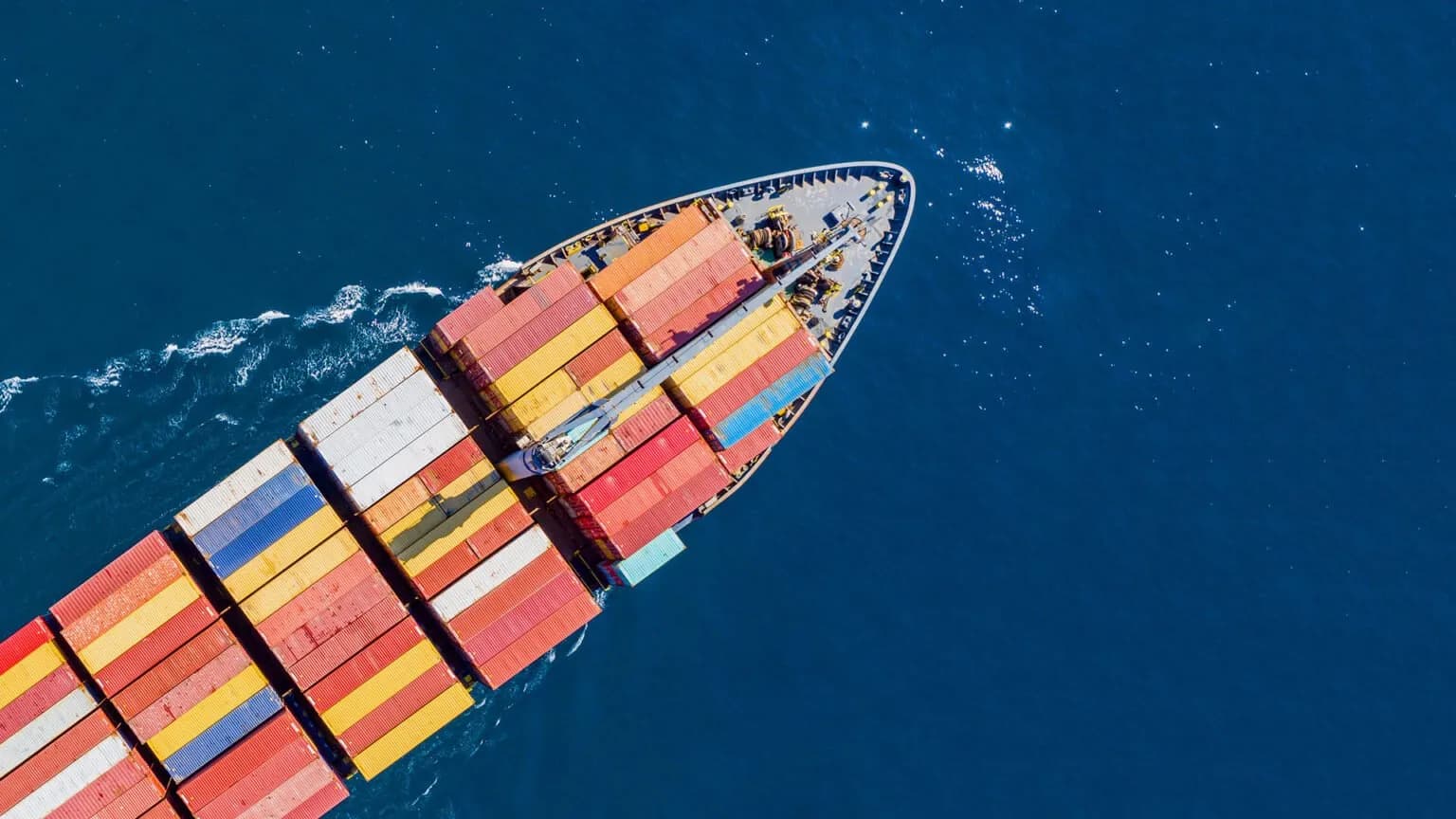
The maritime consultancy Alphaliner has identified five structural trends in the container shipping sector during February 2026 based on its proprietary databases and the tracking of vessels using AIS systems. The analyses cover everything from the acceleration in the adoption of liquefied natural gas (LNG) propulsion and the continued fleet expansion by the largest operators, to changes in traffic patterns through the Suez Canal, differences in the average age of the fleets of major carriers, and record levels of capacity deployed in the Asia-Europe corridor.
The global fleet of LNG-powered container ships has continued to grow following new deliveries recorded in February. One of the most significant developments has been the incorporation of the YM WILLPOWER, a vessel of 15,600 TEUs with dual LNG propulsion built by Hyundai Heavy Industries in Ulsan for the Taiwanese shipping line Yang Ming. This vessel represents an operational milestone for the company, which until now had operated a fleet powered exclusively by conventional fuels. The YM WILLPOWER is the first of five Neo-Panamax units with LNG capacity ordered in 2023, with the remaining deliveries scheduled throughout 2026 and early 2027.
In parallel, the Chinese shipyard New Times Shipyard has delivered the MSC BOSTON, an 11,400 TEU vessel with dual LNG propulsion that constitutes the penultimate unit of a series of ten ships built for MSC. The last unit in the series, the MSC SABRINA, is pending delivery. With these additions, MSC solidifies its position as the largest operator of LNG-powered container ships globally. The company currently operates nearly 90 vessels equipped with this technology, representing over one third of all such ships in active service worldwide. According to Alphaliner data, the global fleet of LNG-powered container ships stands at 239 vessels and an aggregate capacity of 2,831,754 TEUs, of which 171 vessels (2,014,072 TEUs) are owned and 68 (817,682 TEUs) are chartered. 86% of these vessels are less than five years old, reflecting the recent nature of the mass adoption of this technology. CMA CGM ranks as the second operator in terms of the number of LNG vessels, with 76 units.
Data published in February also confirms that MSC (Mediterranean Shipping Company) continues to expand its lead as the world's largest container shipping line. The fleet capacity of the Geneva-based group already exceeds 7.2 million TEUs, representing approximately 21.4% of the global container ship fleet. MSC's expansion is supported by a substantial order book and ongoing acquisitions of tonnage in both the newbuilding and second-hand markets. The shipping line currently holds 2.18 million TEUs of additional capacity in its order book, giving it one of the highest ratios of orders to existing fleet (30.3%) among the ten largest operators in the sector. MSC's fleet is also approaching a new numerical threshold, with 980 vessels in active service. Of these, 727 vessels totaling 4.55 million TEUs are owned, while 253 vessels with a capacity of 2.65 million TEUs operate under charter contracts, representing 36.8% of chartered tonnage. This structure combines asset strength with operational flexibility that has allowed MSC to grow at an unprecedented pace in the sector.
In the ranking of the ten largest operators, Maersk holds the second position with 4.63 million TEUs and 730 vessels, followed by CMA CGM Group with 4.17 million TEUs and 715 units. COSCO Group ranks fourth with 3.59 million TEUs (553 vessels), Hapag-Lloyd in fifth position with 2.38 million TEUs (284 vessels), and ONE (Ocean Network Express) in sixth place with 2.11 million TEUs and 272 vessels. Completing the top 10 are Evergreen Line (1.96 million TEUs), HMM (1.02 million TEUs), Yang Ming (725,719 TEUs), and Zim (704,450 TEUs). Among these operators, Zim presents the highest percentage of chartered fleet, at 86.8%, while CMA CGM leads the order book to existing fleet ratio with 44.4%.

Regarding traffic through the Suez Canal, vessel tracking data supported by AIS indicates that container ship passage has not yet fully recovered, despite announcements from some operators about their intention to return to this route. Both December 2025 and January 2026 recorded year-on-year declines in container ship transits. January's traffic was particularly weak, with 150 transits counted, the lowest figure for a January in the last decade and a year-on-year decrease of 16.7%. Preliminary data for February suggest a possible continuation of this trend, which would mark the fifth consecutive month of year-on-year decline.
Segment analysis by capacity reveals that smaller vessels, below 4,000 TEUs, account for the majority of the decline, with a 33.8% year-on-year decrease in transits in January, although their activity remains significantly above the usual levels prior to the Red Sea crisis. Medium-sized vessels, between 4,000 and 7,500 TEUs, have remained relatively stable, while vessels between 7,500 and 18,000 TEUs have cautiously begun to return since mid-2025. The largest container ships, with a capacity above 18,000 TEUs, crossed the Suez Canal for the first time in over twenty months during December, and a new transit was observed in January. These figures suggest that while traffic is gradually rebalancing among the different segments of vessels, full normalization of flows through Suez has not yet materialized.

Another set of data published in February highlights significant differences in the average age of the fleets of the world's largest container shipping operators. Among the top 20 carriers, Evergreen Line operates the youngest fleet, with an average age of 9.3 years in its nearly 240 ships totaling almost 2 million TEUs of capacity. Wan Hai Lines ranks second with an average age of 9.4 years, followed by HMM with 9.6 years, having recently surpassed the million TEUs capacity threshold. Zim, with an average of 10.6 years, and SITC, also around 10 years, complete the group of operators with the most renewed fleets.
In contrast, the largest carriers by capacity tend to operate older fleets. MSC, despite its market leadership, sits near the lower end of the comparison with an average age close to 17 years. Maersk records an average of 14.9 years, COSCO Group 13.6 years, Hapag-Lloyd 13.3 years, CMA CGM 13.2 years, and ONE 12.6 years. These differences reflect divergent fleet strategies: while some operators prioritize investment in new builds, others rely more heavily on acquisitions in the second-hand market or chartered tonnage.
The last relevant development identified in February concerns the Asia-Europe corridor, where the deployed weekly capacity has reached its highest level ever recorded. For three consecutive weeks, capacity on this route surpassed 521,000 TEUs, setting a new historical high in one of the major arteries of global maritime trade. The Ocean Alliance currently controls the largest share of capacity on the route, at 32.4%. The Gemini cooperation, integrated by Maersk and Hapag-Lloyd, represents 24%, while MSC, which operates independently on this corridor, commands 21.3% of deployed capacity. The Premier Alliance, formed by ONE, HMM, and Yang Ming, controls an additional 16.7%, and operators not integrated into alliances represent the remaining 5.6%. These figures underscore the continued importance of alliance structures and coordinated service networks in shaping the distribution of capacity on the major East-West trade corridors.
