
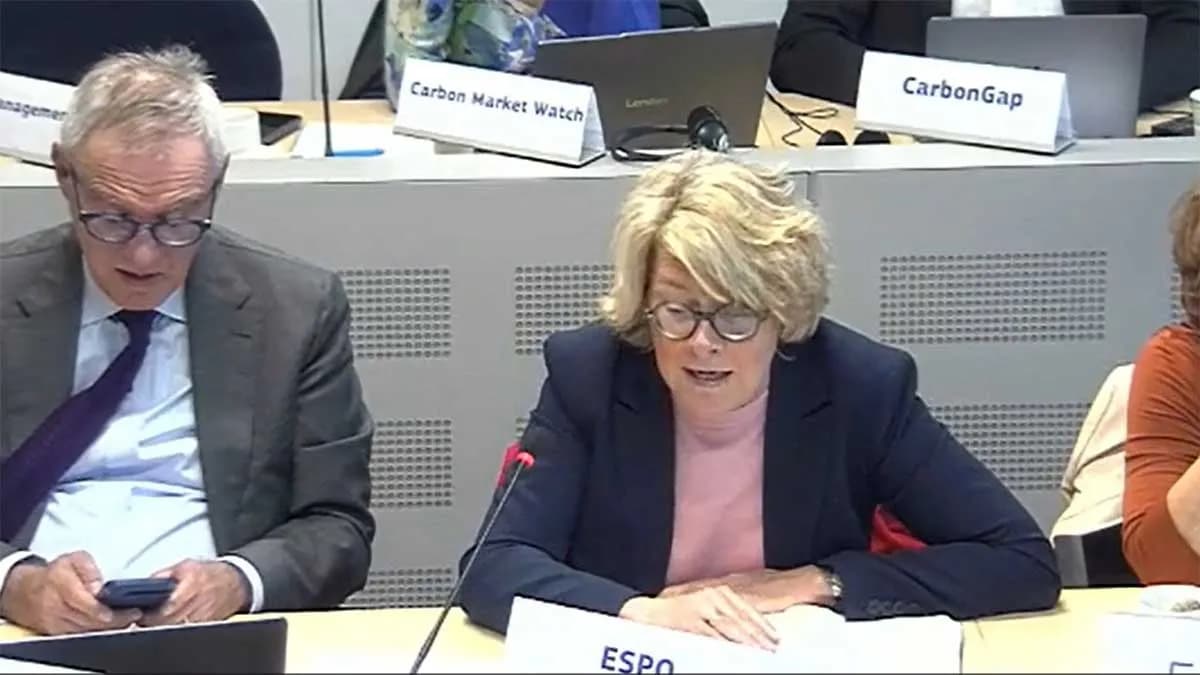
The European Sea Ports Organization, ESPO, has conveyed to the European Commission the need to review the maritime framework of the European Union Emissions Trading System, EU ETS, to correct possible unintended effects on the competitiveness of community ports. The position was presented by its Secretary General, Isabelle Ryckbost, during the high-level roundtable on the review of the EU ETS, held on May 12.
The meeting was organized by the European Commission and gathered about 60 representatives from industrial sectors, aviation, maritime transport, civil society organizations, and other stakeholders linked to the European carbon market. According to the Commission, the meeting is part of the review process of the EU ETS and the Market Stability Mechanism for the period 2031-2040.
ESPO highlighted that the maritime sector had limited representation at the meeting and argued that European ports should participate in the debate on the future application of the ETS to maritime transport. The organization believes that the review should maintain climate objectives but also correct risks associated with traffic diversion, carbon leakage, and competitive distortions between European Union ports and third-country ports.
Maritime transport has been included in the EU ETS since January 2024. The regulation covers CO2 emissions from large ships of 5,000 gross tons or more that enter European Union ports, regardless of their flag. The system applies to 100% of emissions on journeys between two EU ports and during the stay in port, and to 50% of emissions on journeys that start or end outside the EU. The European Commission also notes that methane and nitrous oxide will be incorporated into the system starting in 2026.
The application of the maritime ETS is being implemented gradually. Shipping companies must surrender allowances for 40% of the verified emissions of 2024 in 2025, for 70% of the emissions of 2025 in 2026, and for 100% of the emissions reported starting in 2027. The first surrender date corresponds to September 2025, for emissions declared between January 1 and December 31, 2024.
One of the main points raised by ESPO is the need to maintain balanced competitive conditions between European ports and nearby ports located outside the EU. The organization had already warned in its position on neighboring transshipment ports that the maritime ETS could generate evasion risk, affect the credibility of the system, and compromise the activity of certain European ports if routes are reorganized to reduce regulatory costs.
European regulation already contemplates a specific figure to reduce that risk: 'neighboring transshipment container ports'. According to a document from the European Commission sent to the Council in 2025, calls at these ports cannot be considered as the beginning or end of a journey for the purposes of the Directive, in order to limit the incentive to make evasive calls before or after entering community ports. Currently, that list includes East Port Said in Egypt and Tanger Med in Morocco, which represent around 70% of the transshipment activities carried out in non-EU Mediterranean countries.
ESPO has requested that this list be reviewed to limit route optimization strategies that may reduce the environmental effectiveness of the ETS or shift activity to non-community enclaves. The European Commission itself states that the identification of these ports must be updated every two years and that the system includes monitoring mechanisms to control potential evasion risks.
Concerns about the effects of the maritime ETS have also been raised by Ports of the State through its EU ETS Observatory. In February 2026, the agency presented in Brussels some initial results indicating a reduction in connectivity in long-distance container services scaling at EU ports compared to ports in neighboring countries not subject to the same environmental regulation. The report indicates an 11-point drop in the market share of the main European ports in that segment, measured in TEU-mile, between 2023 and 2025.
ESPO has also claimed that a significant portion of the revenues generated by the EU ETS should be reinvested in maritime and port decarbonization. The organization links this request to the investment needs faced by ports to adapt their infrastructures to new fuels, electrification, energy efficiency, and other solutions aimed at reducing emissions.
The European Commission, for its part, has indicated that the review of the EU ETS must contribute to making the system a driver of investment and innovation in Europe. Among the common priorities identified after the roundtable are regulatory predictability, protection against carbon leakage and investment, access to financing, availability of affordable energy, infrastructure development, and administrative simplification.
ESPO maintains that European ports are strategic assets for the resilience of supply chains, energy transition, and the economic position of Europe. Therefore, the organization has argued for a review of the EU maritime ETS that preserves its environmental objectives while preventing a loss of competitiveness of community ports compared to enclaves located outside the European Union.