
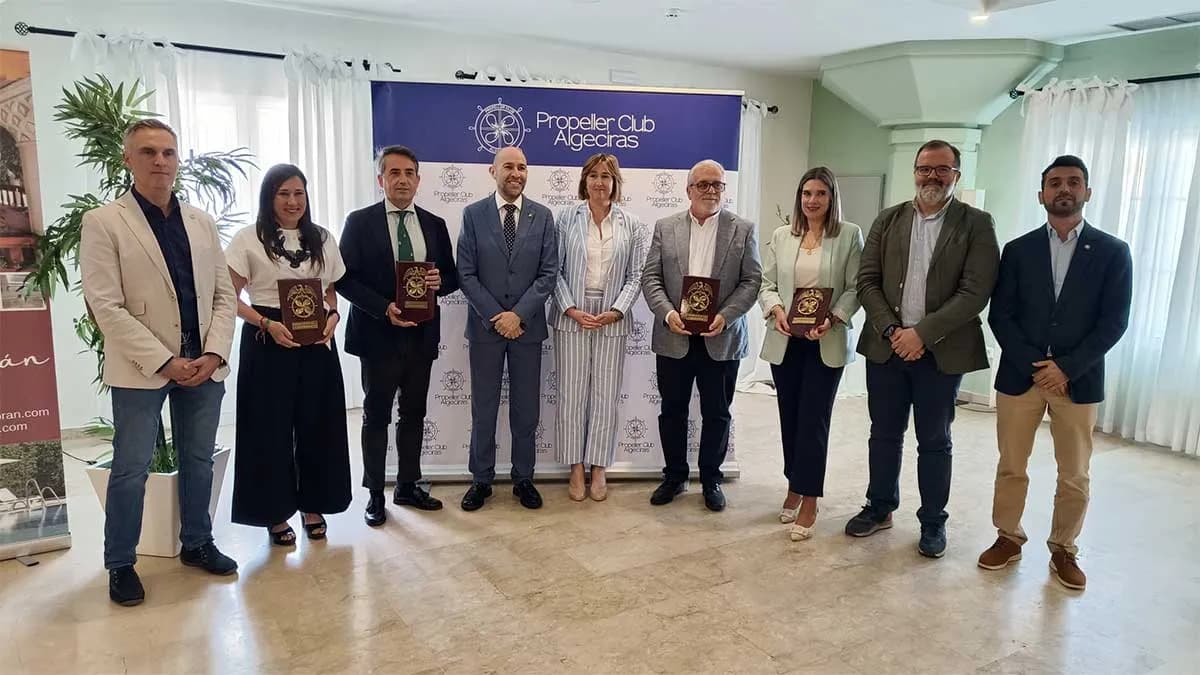
The Propeller Club Algeciras brought together representatives from the main Andalusian political forces this Wednesday to address the main logistical and industrial challenges of the Campo de Gibraltar. The debate featured Antonio Saldaña from the Popular Party; Rocío Arrabal from the PSOE; Carmen Infantes from Vox; and José Manuel Ropero from Por Andalucía.
The president of the entity, Isabel Millán, highlighted the "key" moment the region is going through in a context marked by elections and the strategic importance of the Campo de Gibraltar in national logistical development. The meeting, moderated by Manuel Piedra, began with a minute of silence in memory of the two Civil Guard officers who died last Friday.
The first block focused on land infrastructure, energy capacity, and the railway and road connections of the region, as well as the impact of the future agreement on Gibraltar. José Manuel Ropero (Por Andalucía) demanded greater state involvement to expand the electricity grid, complete railway electrification, and ensure that the energy transition generates wealth and employment in the region. Regarding Gibraltar, he advocated for consolidating a space for cross-border cooperation based on labor rights and fiscal and environmental harmonization.
Antonio Saldaña (PP) described as "absurd" the lack of electric capacity to develop industrial projects linked to the Port of Algeciras and denounced that millions in investments could be lost due to the absence of infrastructure. He also called for "positive discrimination" for Andalusia in terms of investments and advocated completing the modernization of the Algeciras-Bobadilla line before addressing new railway connections. Regarding Gibraltar, he considered the debate over sovereignty to be "outdated" and called for focusing on the economic and logistical opportunities for the region.
From Vox, Carmen Infantes criticized European energy policies, the closure of industries such as the thermal power plant in Los Barrios, and the lack of investments in infrastructure. She also rejected the agreement on Gibraltar, calling it a "scam" for Spain and argued that any solution must involve restoring Spanish sovereignty.
Rocío Arrabal (PSOE) defended the central government's investments in both energy and railway sectors and called for institutional dialogue to advance strategic projects. Regarding Gibraltar, she stated that the agreement could become an opportunity for shared prosperity, although she demanded guarantees for the logistics and customs sector.
During this block, the creation of a Special Economic Zone for the Campo de Gibraltar was also discussed, a proposal supported by all participants, albeit with different nuances regarding taxation, employment, and investments.
The second block was dedicated to port development, the outer anchorage, and the impact of environmental regulations on maritime competitiveness. Antonio Saldaña defended the need to execute the outer anchorage for security and competitiveness reasons, criticizing the environmental barriers that, in his opinion, hinder the port's growth and benefit other competing locations. José Manuel Ropero called to reconcile port expansion with greater environmental guarantees and with the protection of sectors such as fishing and tourism. Rocío Arrabal insisted on the importance of meeting all environmental procedures and allegations, while Carmen Infantes urged prioritizing national investments and the competitiveness of Spanish ports.
Regarding the ETS emissions system, all participants agreed that European regulations affect the competitiveness of ports in southern Europe. While the PSOE advocated for investments in decarbonization and port electrification, PP, Vox, and Por Andalucía called for mechanisms to avoid disadvantages compared to non-EU ports.
The last block focused on the role of the airports of Gibraltar and Jerez, as well as the possibilities for aeronautical and logistical development in the province. Saldaña defended the complementarity between both airports, although he expressed doubts about the viability of a large cargo hub in Jerez. Arrabal advocated for taking advantage of all available infrastructures and studying new investments related to the aeronautical sector. Ropero called for feasibility studies before new airport projects. Infantes defended any project that improves the province's international connectivity.
The debate concluded with a general consensus on the need to expand vocational training linked to the logistics, port, and aeronautical sectors to respond to business demand and the industrial growth of the region.